If you have ever received a bad file in email or a great big box of outdated floppy discs made by a distant and now dead cousin, you will appreciate the following article. Actually, you'll enjoy reading the article even if your files have been pristine.
Preserve often-- preserve well..........
The link in the Dick Eastman article will take you to the white paper. Read it, ponder the super information presented-- and then join me as I search for an achival data reader..........
The following article is from Eastman's Online Genealogy Newsletter and is copyright by Richard W. Eastman. It is re-published here with the permission of the author. Information about the newsletter is available at http://www.eogn.com.
I have written several times about the advantages and disadvantages of storing records digitally for many years, both your personal records as well as the holdings of major archives and records repositories. Now Gary Wright, an employee of FamilySearch, has written a definitive whitepaper on the subject that explains the issues involved with digital archiving. He describes in detail the pitfalls of digital storage of priceless paperwork and of old family photographs that have been digitized. As he explains, if done right, digital archives will last for decades. If done wrong, they may not last three years.
I had a chance to read this whitepaper a few weeks ago when Gary circulated it amongst a number of people in the industry, asking for our comments. I told Gary at that time that he had to publish it on the web and, when he did, to please let me know the address so that I could inform the readers of this newsletter. After all the comments were in, Gary did exactly that. White Paper: Preserving Your Family History Records Digitally is now available on the FamilySearch.org web site at https://wiki.familysearch.org/en/White_Paper:_Preserving_Your_Family_History_Records_Digitally
I would suggest you read this whitepaper and consider the information within it carefully. Then forward copies to all your genealogy friends, society members, and anyone else with an interest in genealogy. I think every genealogist as well as every person who has heirloom documents and photographs in his or her possession should read White Paper: Preserving Your Family History Records Digitally at https://wiki.familysearch.org/en/White_Paper:_Preserving_Your_Family_History_Records_Digitally
---
Ahh genealogy. How do I digitize? Let me count the ways........
©2010 AS Eldredge

Ahhh, genealogy. A glimpse of the past shows of what I am made.....
Friday, October 22, 2010

Tuesday, October 19, 2010
Founders to go Online
Thought you'd enjoy knowing this fun little tidbit from the National Archives......
National Archives to Put the Founders Online
The National Historical Publications and Records Commission (NHPRC), the grantmaking arm of the National Archives, is pleased to announce a cooperative agreement with The University of Virginia (UVA) Press to make freely available online the historical documents of the Founders of the United States of America.
The NHPRC and UVA Press will create a new web site which provides access to the fully annotated published papers of key figures in the nation’s Founding era. The project is designed to include the papers of George Washington, John Adams, Thomas Jefferson, James Madison, Alexander Hamilton, and Benjamin Franklin. The National Historical Publications and Records Commission will provide funding in the amount of up to $2 million for the UVA Press to undertake the work on the published papers.
Through this web resource, users will be able to read, browse, and search tens of thousands of documents from the Founding Era. A prototype web site including the contents of 154 volumes drawn from print editions of the papers of Washington, Adams, Jefferson, and Madison will be prepared by October 2011. The fully public version will be launched by June 2012 and will also include the 27 volumes of the Papers of Alexander Hamilton. By June 2013, the Founders Online expects to add the 39 published volumes of the Papers of Benjamin Franklin. The new resource will include the complete contents of 242 printed volumes, including all of the existing document transcriptions and the editors’ explanatory notes.
“This new archive of the Founding Era will revolutionize our understanding,” said David S. Ferriero, Archivist of the United States, “by creating for the first time a free and fully searchable collection of the Founders’ own words in the context of their time. As scholars and statesmen debate the meaning of documents such as the Constitution and Bill of Rights, they can turn to the originals and the wit and wisdom of the Founders’ own debates. And we can only express our gratitude for the effort of dedicated editors and scholars to create this work, a national monument to the founding of our nation.”
This award to help the University of Virginia Press create a new online presence for the papers of our nation's founders is great news for the University and for scholars everywhere," said University President Teresa Sullivan. "For ten years, the Press has built on the pioneering vision of U.Va. faculty to harness digital technology in the service of scholarship and education through the Rotunda imprint. As a public university, we applaud the leadership of the National Archives in bringing this important archive to life. Making these materials available to the public for free reflects the core values of the University and indeed of our nation's founding generation, whose words will now be readily available to teachers, students, and citizens.”
Historian Ron Chernow, author of the recent biography Washington: A Life, said, “Unfortunately, the Founders have become remote and abstract, when in fact they are rich, full-blooded, and fiery characters. This new site will not only help students learn more deeply and develop a visceral love and respect for this era, but it will stimulate interest in history for teachers, too, and will reconnect them to primary sources.”
In conjunction with entering into the cooperative agreement, Archivist David S. Ferriero also announced the appointment of three leading scholars to a special Founding Fathers Advisory Committee. The three members are Edward L. Ayers, President of University of Richmond, and leading scholar on the Civil War and American South; Mary Beth Norton, Professor of American History at Cornell University, and leading scholar on the social and political era of the 17th and 18th century America; and David Hackett Fisher, Professor of History at Brandeis, a leading scholar on the colonial era and Pulitzer Prize-winner author of Washington’s Crossing (2004). The Committee will advise the Archivist on the progress of the Founders’ editorial projects, and it is scheduled to meet at the National Archives on December 13, 2010.
Ahhh, genealogy. So much reading, so little time.....
©2010 AS Eldredge
Wednesday, October 13, 2010
Have to Reach Out to Research in PA for a While
While the PA Archives will be closed to the walking, talking, visiting public for the next several months, all is not in despair. They will still process inquires if you talk or write to them.....
Pennsylvania State Archives to Close for Four-Month Renovation Project
/PRNewswire-USNewswire/ -- The Pennsylvania Historical and Museum Commission (PHMC) announced today that the State Archives of Pennsylvania will close from Oct. 18 through Feb. 3, 2011, for needed renovations.
While Oct. 16 is the final day researchers can visit the facility at Third and Forster streets in Harrisburg, staff will continue to respond to telephone, e-mail, and postal inquiries during the renovations.
Barbara Franco, PHMC executive director, said the $250,000 project will expand and modernize the existing lobby and public research areas. A larger vestibule is required to facilitate access for people with disabilities and will include automatic doors. The work will provide more space for the increasing number of researchers, as well as new wiring and additional computers to improve access to the collections. Security systems will also be upgraded.
While the renovations will extend the life of the building, plans are still in process to replace the 50-year-old facility that is nearing its capacity. Water leaks exist. The facility lacks adequate environmental controls or fire suppression systems to protect its more than two hundred million pages of one-of-a-kind records, including the Charter from King Charles II to William Penn creating the colony of Pennsylvania.
The Pennsylvania Historical and Museum Commission operates the State Archives. Visit the archives online at PHMC's website, www.phmc.state.pa.us, and choose the State Archives link. For further information about the closure or to make research inquiries, call 717-783-3281.
Ahh, genealogy. Sometimes you just can't walk the walk. Sometimes, you just have to talk.
©2010 AS Eldredge
Politicians are All in the Family Thru Early Plymouth Connections
Another day, another genealogy find. I find this story from Ancestry.com of interest if only to show we are pretty much all connected to each other one way or another. We may not share any common interests in the present with some of our extremely distant kin, but we are probably more alike than we realize. Take, for instance, ....
Ancestry.com Reveals Midterm Election Connections: President Obama Related to Palin and Limbaugh
/PRNewswire/ -- As Americans prepare to cast their votes in November's mid-term election, Ancestry.com today announces that several key political leaders and media personalities are more than mere political allies or political foes—they are actually related.
The world's largest online family history resource reveals that President Barack Obama is related to former Alaska Governor Sarah Palin. Obama and Palin are 10th cousins through common ancestor John Smith. The website also found that Obama is related to one of his most vociferous critics, conservative radio talk show host Rush Limbaugh. Perhaps Rush will ease up on the President when he learns they are actually 10th cousins once removed via common ancestor Richmond Terrell.
Ancestry.com researchers also discovered that Palin, Senate Majority Leader Harry Reid and conservative author Ann Coulter are also cousins through Englishman John Lathrop, who was exiled to the United States for becoming a minister of an illegal independent church.
But the connections don't end there. Obama, Palin and former President George W. Bush are also related. Obama and Bush, who both reached the highest office in the land, are 11th cousins through common ancestor Samuel Hinckley. Palin and Bush, who are also 11th cousins, are also related through Hinckley. Apparently leadership runs in the family, since Hinckley's son, Thomas, went on to become governor of Plymouth Colony.
"We have all watched the heated media coverage as the leadership of Congress is at stake in this very contentious upcoming November election," said Anastasia Tyler, a genealogist at Ancestry.com. "It is not unusual, however, to find family members on different ends of the political spectrum. This election season is an ideal time to look into the family trees of our candidates and their critics to learn more about the ties that make them all part of this great country."
Other Famous Finds
These newfound family connections between our nation's top political players are the latest of several discoveries from the research team at Ancestry.com:
* In 2009, Ancestry.com discovered that Obama and financial investor Warren Buffett are more than just allies. The two men are 7th cousins three times removed.
* Ancestry.com also revealed that Obama and actor Brad Pitt are 9th cousins.
* In 2008, Ancestry.com announced that then-Governor Sarah Palin is a distant cousin to both Franklin D. Roosevelt and Princess Diana.
Ancestry.com recently announced it has extended its relationship with NBC for the second season of the hit television series "Who Do You Think You Are?" Ancestry.com worked with NBC on the first season of "Who Do You Think You Are?" that debuted in March 2010, providing important family history research for the show, including tracing the roots of the seven celebrities featured.
As for my roots, I do have White House connections to a president, but not the current one. My blood kin there was James Buchanan. A presidential gold coin was just released for Buchanan-- I've got one.
Ahh, genealogy. How many blood lines are hanging around in the ole proverbial woodpile?
©2010 AS Eldredge
Saturday, October 09, 2010
Playing Your Song for Eternity?
This morning, before the caffeine hit the bloodstream, I received a weird story from one of my genealogy buds. Could it be an early Halloween joke? It appears there is a company across the pond who will immortalize people or pets by pressing their cremated remains into a vinyl record.
Vinyl record? This group even offers album cover art with either a photograph of the dearly departed or a painting. Customize the album with a last message, will, directions, or music and you're ready to go.
After I chuckled at the grim reaper and blood spatters on the website, I wondered how many people could even play a vinyl record. I think I have a record player tucked away somewhere deep in the dungeon here at the house.
I kind of like the idea of leaving a recording of my voice for my future family members, but I think I will just turn on my video camera for the occasion. And, my family can always raid the computer and old photograph album books for numerous examples of my smile.
I think I will pass on the offer to spend eternity pressed on a vinyl record. I think I would rather be pressed into the heart and memories of my loved ones.
Ahh, genealogy. And the beat goes on.........
©2010 AS Eldredge
Thursday, October 07, 2010
Marking Veterans Final Resting Places
Chances are you have some veterans in the family. Have you thought of honoring the memory of their desire to protect our great land and the freedoms you enjoy? It's easy and I encourage all genealogy and history buffs to honor your loved ones.
My grandfathers both served America in World War I. One was in the Army and suffered from the exposure to mustard gas. Click here to read more of Charlie and his World War I experience and subsequent death. The other grandpa was in the Navy for a short stint, and died happily at an old age.
While my dad is buried in a military cemetery and has an official veterans marker, my grandfathers do not. Since my grandpas both have headstones at their final resting spot, I have not had the reason to seek honoring their military service with a government issued headstone. But wait-- can I do it now?
Just recently, the Department of Veterans Affairs announced a new option to honor our veterans who are buried in private (non-government) cemeteries and who have privately purchased headstones.
Now, we can honor our veterans' service to our great land with the addition of a bronze medallion to the existing headstone. For veterans who died on or after November 1, 1990, the medallion can be ordered through the VA. For more information on the medallion option, visit http://www.cem.va.gov/hm/hmtype.asp
Perhaps, the VA will soon have these medallions available for veterans who died before 1990. Wouldn't that be great?
Ahh, genealogy. Loving the past and wanting to honor my special veterans--- always and all ways.
©2010 AS Eldredge
Family Tree Maker for Macintosh Pre-Sale
The following article is from Eastman's Online Genealogy Newsletter and is copyright by Richard W. Eastman. It is re-published here with the permission of the author. Information about the newsletter is available at http://www.eogn.com.
Ancestry.com announced last spring that the company would re-introduce Family Tree Maker for Macintosh before the end of the year. Apparently, the company plans to meet that deadline. The product isn't available yet but Ancestry.com is now taking orders and is promising delivery in "early November." Best of all, those who order the product now will receive a 20% discount.
A new page has appeared on Ancestry.com's online store to says (in part):
Family Tree Maker for Mac - Pre-Sale
20% Off
Introducing Ancestry.com Family Tree Maker for Mac
For 20 years, Family Tree Maker has been the #1-selling family history software. Millions of people have used it to discover, preserve and share their family stories. Now Mac users can too.
Family Tree Maker for Mac, which is based on Family Tree Maker 2010, makes organizing, researching and sharing your family history easier than ever, whether you're just getting started or already an expert.
The web site then goes on at some length giving details of the new program's capabilities. To be blunt, it all sounds identical to the capabilities of the Windows version and I'd suggest that is a good thing.
Near the bottom of the web page, it says "This item has not yet been released. It will be released and shipped in early November."
Family Tree Maker for Macintosh will retail for $69.95. The Ancestry.com online store is offering it as a "pre-sale" for a 20% discount: $55.96.
I ordered my copy today.
You can find Ancestry.com's online description and order page at http://store.ancestry.com/ProductDetail.aspx?P=P-4845&cj=1&o_xid=0002370517&o_lid=0002370517
Friday, September 24, 2010
Lost in Memory Lane
Fall has come and now it is time for the cleaning to begin. I've got to put up all the reminders of long, hot, lazy summer days. Gone are the beach towels, bathing suits and sunscreen.
In are the new school pictures of the kids. While I was adding the new pictures this morning, I took time to look at all of the school pictures behind the current one. Smiles and memories flood me as I look at those precious children who are now so grown up.
I paused and remembered my childhood. How much fun it was to go into my parents' room and look at the pictures in the frames. I liked to take them apart and look for any treasured pictures that were behind the photograph they had on display. Many a time, I found pictures of my parents when they were younger, and sometimes, I found pictures of my siblings and me when we were just little sprouts. Those fancy Easter Sunday dresses and ill fitting suits for the boys. Just thinking about those old photographs today set me on a course of thinking and remembering the past.
I so miss the hugs, the dogs, my grandmother, my grandfather, and most of all, my parents. I guess I'll spend some more time on Memory Lane today, before I get too old to be able to retell those old stories to my kids.
Ahhh, genealogy. Ain't it a sight for sore eyes!
Wednesday, September 08, 2010
Wordless Wednesday: Shooting It Up at the Alamo
The Alamo? I had family at the Alamo? Imagine my surprise when my cousin through our joint 4ggrandfather told me the story. I was so taken back that I asked him to write down the story so I could share it with you. Terry took his documented information on Robert Cunningham and interspersed it with history excerpts of the Alamo and Texas found online. The story of cousin Robert and his place in destiny is fascinating as it brings history in focus for our family--- and maybe, yours.
Robert W Cunningham: The Alamo
by Terry Prall
Robert W. Cunningham¹ was born on 18 Oct 1804 in New Berlin, Chenango Co., New York.² He died killed defending the Alamo on 6 Mar 1836 at the age of 31 in The Alamo, San Antonio de Bexar, Republic of Texas.²
Robert W. Cunningham was the eldest of the children of David Cunningham and Anna Jennison, born in Chenango Co., New York in 1804. He made the move west with his family as they settled in Jeffersonville, Clark Co., Indiana during the 1820s.
Robert opted for a life on the river, common to his Cunningham, Jennison and Simmons kin. Members of the family lived along the Ohio river towns in Kentucky, Indiana and Ohio throughout the 1800s. Cunningham spent time in Kentucky and Arkansas before working on the Mississippi River cargo flatboats that took him to New Orleans. In 1832 Robert wrote his family back in Jeffersonville that he was going to settle in New Orleans. That decision was soon to change.
Texas beckoned.
By 4 March 1833 Robert had moved to Texas where he received title to a league of land on Skull Creek [present-day Colorado Co.] in Austin's burgeoning colony. [His name appeared on the tax index list of 1833 in "Austin County."]
Moses Austin laid the foundation for an American settlement in Mexico's northern-most state, Texas, in 1820-21. He was granted land on which to settle 300 families by Governor Martinez. Moses died in June of 1821 and his son, Stephen F. Austin, reluctantly took over the Texas Grant. The new "Empressario" met with the governor's representative in San Antonio and laid out an acceptable plan for settlement. He then returned to New Orleans to advertise for colonists. Austin led the first families into Texas in 1822 and soon had to go to Mexico City to confirm the grant.
During his return to the colony, the Mexican government fell to revolution. The new Constitution of 1824 was loosely patterned after that of the US. There were serious differences - no trial by jury, Roman Catholicism was the state religion, Congress had the final say in interpreting the constitution, the president had the right to command the army in person and the rights of the states were not clearly defined. Slavery had been all but outlawed in Mexico, but there were some allowances. Coahuila and Texas, the northern-most states, were combined into a single state. Distribution of land favored native Mexicans over colonists. Colonists had to swear to follow the constitution, including following the Catholic faith. Other colonies sprang up in Texas over the next few years. Austin's was by far the most successful and continued to grow. Changes were on the horizon with another revolution in 1829 and one of its leaders, a hero of the previous war, was Antonio Lopez de Santa Anna. The U.S. was making noise about annexing Texas. Slavery was outlawed. Vice-president Bustamente declared himself president in 1830 and forbade further colonization of Texas. Juan Matin Verimendi was elected vice-governor of Coahuila y Texas and into the picture came Verimendi's son-in-law, James Bowie. Among new government officials in Texas was Col. Juan Bradburn, in charge of Anahuac. He instituted martial law, conficated colonists' property, citizens were arrested, Mexican soldiers robbed and stole and went unpunished. In 1831, enraged citizens arrested one of Bradburn's soldiers. They were in turn arrested by Bradburn. One of them was a young attorney named William Barrett Travis.
The prisoners were eventually released and Bradburn sent to New Orleans, from where he promptly retuned to Mexico. As Santa Anna continued to lead the revolt, Sam Houston arrived in Texas in 1832. Santa Anna was elected president in 1833. It was shortly before Santa Anna took office that 29 year-old Robert Cunningham arrived in Texas. Santa Anna was soon dictator of Mexico, the Constitution of 1824 was abolished and the rights of Mexicans and colonists alike were revoked. The Texans tried reason before rebellion and sent Austin to Mexico City with their grievances in 1834. He was promptly arrested and imprisoned. Austin was released later in the year.
1835: The state of Zacatecas was opposed to the new dictator and prepared to defend itself from the encroaching Mexican Army led by El Presidente himself. Of 5000 Zacatecas defenders, 2000 were killed and 2700 were taken prisoner. For two days, Santa Anna's army butchered citizens and plundered the state capital. Meanwhile, General Cos, the dictator's brother-in-law, was dispatched to Coahuila y Texas to shut down the legislature and establish martial law. The mood among Texas colonists was quickly shifting to one of independence. Travis led a force to take Anahuac. Austin returned in September, now ready to support the rebels and a Committee of Safety was formed at San Felipe. The town of Gonzalez had been given a cannon for protection against Indian raids. Mexican forces were sent to reclaim the cannon. They were not successful. The Texans captured Goliad and Concepcion. Plans were underway at San Felipe to establish a provisional government. A declaration was written calling for a return to the Constitution of 1824. By the end of November, Henry Smith was appointed governor, James W. Robinson lieutenant governor, Austin commissioner to the U.S. and Sam Houston was commander-in-chief of the army. They would meet at Washington-on-the-Brazos on 1 March 1836 for further action. General Cos' army was now encamped in San Antonio de Bexar and in an old, run-down Spanish mission outside of the town - the Alamo.
What transpired in the life of Robert Cunningham between March of 1834 and late 1835 is not yet documented; he wrote his family in 1836 that he had joined the Texas army. He was undoubtedly with the army as it moved from Concepcion to San Antonio in November and December of 1835. Robert was serving as a sergeant and second gunner in Captain T.L.F. Parrott's artillery company.
Parrott's company was initially under Austin's command, but Austin was called away and Edward Burleson took command of the regiment. Burleson gave the order to attack the Mexican forces on the evening of December 4th. Ben Milam led the assault on the town, while James Neill attacked the Alamo. There was much house to house fighting over the next five days. Among the most notable casualties of the battle was that of Col. Ben Milam on the 7th. Milam had been an inspirational leader of the Texas. Cannon fire helped keep Mexican forces from leaving the Alamo to reinforce Bexar. By the 9th, Cos' troops had retreated to the old mission and ran up a white flag. In the early morning hours of 10 December 1835 Cos surrendered. Cos and his officers were never to return to Texas, nor were they to, in any way, oppose the reinstitution of the 1824 Constitution. Santa Anna, at the head of an army of 6000, was marching toward the rebellious colony.
Robert Cunningham chose to remain with the Bexar garrison. He was assigned to Captain William R. Carey's artillery company as a private. Cunningham was part of the force of fewer than 100 regulars left to man San Antonio de Bexar under the command of Col. James Neill.
Col. James Bowie arrived on the 19th of January with 30 men and orders [left to Bowie's discretion] to abandon Bexar, blow up its fortifications, and remove the artillery to Gonzalez. Neill disagreed. Bowie took stock of the situation and finally agreed with Neill that holding Bexar was crucial. Bowie wrote Houston stating that "we would rather die in these ditches than give it up to the enemy." The commanders began to fortify their defenses.
Governor Smith ordered Travis to Bexar. Travis made several pleas to have his orders revoked and even threatened to resign his commission. In the end, Col. Travis led his 30 men into Bexar on February 3rd. On the 6th arrived the Tennessee Mounted Volunteers under the command of former Congressman Col. David Crockett. Crockett proceeded to regale the soldiers and citizens with stories of his exploits. David informed them that he had told Congress that "you may all go to hell and I will go to Texas. Neill left on 20 days leave on the 11th and placed Travis in command of the regulars.
Bowie was drinking heavily and suffering from bouts of fever [probaby typhoid or pneumonia] and constantly at odds with Travis. Finally, on the 14th, they agreed to maintain their separate commands and make major decisions together.
23 February 1836: Sentries see guidons on the horizon. Orders are given to evacuate Bexar and move into the Alamo. Santa Anna had arrived. Santa Anna, under a white flag, demanded the surrender of the Alamo. He was answered with a cannon shot. A blood red flag was raised in Bexar - no quarter, no prisoners - the Alamo garrison was to be put to the sword.
Travis drafted a letter on the 24th and sent it out through Mexican lines:
COMMANDANCY OF THE ALAMO, BEXAR, February 24, 1836.
FELLOW-CITIZENS AND COMPATRIOTS : I am besieged by a thousand or more of the Mexicans under Santa Anna. I have sustained a continued bombardment for twenty-four hours, and have not lost a man. The enemy have demanded a surrender at discretion ; otherwise the garrison is to be put to the sword, if the place is taken. I have answered the summons with a cannon-shot, and our flag still waves proudly from the walls. I shall never surrender or retreat. Then I call on you in the name of liberty, of patriotism, and of everything dear to the American character, to come to our aid with all despatch. The enemy are receiving reinforcements daily, and will no doubt increase to three or four thousand in four or five days. Though this call may be neglected, I am determined to sustain myself as long as possible, and die like a soldier who never forgets what is due to his own honor and that of his country. Victory or death!"W. BARRET TRAVIS, Lieutenant-Colonel commanding." P. S.—The Lord is on our side. When the enemy appeared in sight, we had not three bushels of corn. We have since found, in deserted houses, eighty or ninety bushels, and got into the walls twenty or thirty head of beeves. "T"
Other riders were sent out to deliver dispatches and pleas for help. Skirmishes took place between Mexican and Texan troops. The Alamo was constantly bombarded by Mexican artillery. Return fire was sporadic. Forage parties were sent out to find food and firewood. The Texans also managed to put to torch a few nearby huts that would provide cover for the enemy. Miracuosly, there were no deaths among the defenders. Bowie's illness had won out - he was now a bedridden non-combatant. Travis was in full command.
The artillery headquarters of Capt. Carey was in the southwest corner of the compound. It may have been there, at Alamo's 18 pounder, or the battery trained on the main gate on the south wall to which Pvt. Cunningham was assigned. From his post he witnessed the shenanigans of fellow artilleryman, Scotsman John McGregor and Crockett. McGregor on his bagpipes frequently duelled Crockett and his fiddle. When not at his post at the southeast barricade joining the south wall to the church, Crockett was found around the compound trying to keep spirits up. Periodically David would scale the southwest wall and take shots at enemy soldiers within range. On one occasion he took aim on a Mexican engineer 200 yards away - and shot him dead. Life was anything but boring for young Cunningham.
On March 1st, 32 men arrived from Gonzalez to reinforce the Alamo. Still believing that reinforcements were on the way from Goliad, Travis sent Crockett and two others to find the men and lead them back to the Alamo. About twenty miles out, Crockett's party located the party of about 50. Crockett got most of the men safely inside the Alamo; the others were driven off by the Mexicans. The last messengers were sent out on the 5th. The defenders of the Alamo had not received word that the provisional government had declared Texas an independent republic on March 2nd.
Santa Anna called for an all out attack on the morning of the 6th and ended the bombardment about 10:00 P.M. on the 5th. The exhausted defenders inside the Alamo slept.
At about 5:00 A.M. the Alamo sentinels outside the walls were killed in their sleep as the advance troops approached. Overly enthusiastic soldiers shouted "Via Santa Anna!" and brought the Alamo to life. Santa Anna ordered the 'Deguello' [cut throat song] to be played.
A three acre compound that required 1000 men to adequately defend it, had perhaps 200-220. Crockett's Tennesseeans repelled multiple assaults, forcing the enemy to the west. At the north wall, two assaults failed, but the third did not. Travis, at the north wall, was one of the first to fall. The Mexican troops swarmed over the north wall. Texans exposed to musket fire were cut down. Others abandoned their positions and fought a retreat toward the two barracks and church.
Robert Cunningham and the other artillerymen fired into the masses of Mexican soldiers filing into the compound from the north. As their shot ran out, they grabbed nails, scrap metal, door hinges and anything else they could load into their cannons. The "scrap shot" nearly wiped out one entire Mexican company. The south wall was left unguarded as guns were trained on the north. Battery by battery the artillerymen were overrun. At some point during the push over the south wall, the 32 year-old artilleryman from Jeffersonville fell next to his cannon riddled with musket fire or pierced by bayonets.
The north and south walls had been breached. Mexican troops scaled the east wall and entered the foray. The defenders there escaped into the prairie and, despite cover fire from Captain Almeron Dickinson's artillery on the church, were slaughtered by the enemy cavalry. Defenders jumped from the west wall and tried to fight in the ditches near the mission.. They were also cut down by the Mexican cavalry. Many defenders took refuge in the long barracks [west wall] and the low barracks [south wall].
Crockett and his men were still in the open, backed up against the southeast palisade and in front of the ruins of the church. They put forth a desperate last stand. Witnesses reported between 15-20 soldiers piled around Crockett and a couple of his men.
Captured cannons were turned on the doors and walls of the two barracks, tearing brick and defenders to pieces. Soldiers stormed the buildings firing point-blank into the Texans reduced to hand-to-hand combat. Bayonets finished the job. Soldiers stormed into Bowie's room and found him lying near death in his bed. Legend holds that he generated enough strength to discharge a set of pistols and bury his famous Bowie knife into one of the enemy. His body was raised on bayonets like a bale of hay.
The Alamo's 18 pounder was turned on the church by Mexican soldiers and blew apart the doors. Dickinson's artillerymen and the remaining Texans who had taken refuge in the church were quickly overrun. A handful of men were captured and taken before Santa Anna - they were executed on the spot. By 6:30 A.M. it was all over.
Survivors? At least 14. The wife and children of defender Enrique Esparza and a few other Mexican women and children. Travis' slave, Joe. Susanna Dickinson and her infant daughter were the only Anglo survivors. Mrs. Dickinson and Joe were sent north to tell of the fall of the Alamo.
Santa Anna ordered Christian burials for his dead [estimates between 600 and 1200]. Many bodies had to be tossed into the nearby creeks and rivers. As to the Alamo defenders they were stacked - a layer of wood, a layer of bodies..... and put to the torch. Only one, Enrique Esparza, whose brother fought for Santa Anna, was granted burial.
It is not known how long it took the news of the fall of the Alamo to reach the Cunninghams in Jeffersonville, Indiana. Reports would have begun making their way from New Orleans up the Mississippi by the end of March. News of Robert's death may not have reached the Cunningham family until late April.
By that time, Sam Houston and the Army of Texas had exacted a measure of revenge. On 21 April 1836 the Texans, with the battle cry, "Remember the Alamo!", overwhelmed Santa Anna's forces at San Jacinto, killing 650 and capturing 700 in an 18 minute battle. Houston's force of just under 800 suffered 9 dead and 34 wounded. Among the Mexican prisoners was a soldier in a corporal's uniform. Upon seeing him, other prisoners shouted, "El Presidente!" A disgraced Santa Anna was brought before Houston and signed Texas over to the general in exchange for his life.
Robert W. Cunningham, born in New York, resident of Jeffersonville, Indiana, with stops in Kentucky, Arkansas, New Orleans, and numerous towns along the Mississippi decided to settle in Texas in 1832. On the 6th of March 1836 at the Alamo, he joined David Crockett, Jim Bowie, Travis and the others in immortality.
Sources for excerpts:
The History of Texas: http://www.sonofthesouth.net/texas/history-texas.htm
Battle of the Alamo [wikipedia]: http://en.wikipedia.org/wiki/Battle_of_the_Alamo
-------
1. Bill Groneman, "Cunningham, Robert W.," biographic sketch, Texas State Historical Association, The Handbook of Texas Online (http://www.tshaonline.org/handbook/online/articles : accessed 29 January 2010).
2. Wall Street John, William F. Archerd online [http://wc.rootsweb.ancestry.com/cgi~bin/igm.cgi?op=GET&db=wallstreetjohn&id=194&pr...], accessed 6 November 2009.
Note: Current online for Wall Street John, Ann S Eldredge [http://wc.rootsweb.ancestry.com/cgi-bin/igm.cgi?op=GET&db=wallstreetjohn&id=I110]
------
Ahh, genealogy. Sometimes, it can just leave you in awe of history.
©2010 AS Eldredge
Friday, September 03, 2010
Are Your Aliens Lost?
Have you ever thrown your hands up in despair when the trail to your early family leads nowhere?
I suspect every family researcher suffers that same feeling as we exclaim, "They were aliens! Came to earth in between the census years, procreated, and left."
Of course, it is even more frustrating to know where they were at any given time in history, but be unable to document it legally. Oh, why couldn't they leave wills? Why didn't they prepare when they knew their life expectancy was limited?
Another genealogy buff just sent this and I thought you'd like to see it, too. Perhaps, this could be of value to those who are searching for their own personal alien from 1798-1828.
Go to the National Archives and check their landing records. Landing records were kept in the United States for aliens who desired to be naturalized. This could lead to a great find!
Here is the link to check it out: http://blogs.archives.gov/online-public-access/?p=2125
Ahh, genealogy. Guess we were all aliens at one time.
HT to Family Tree Mag
©2010 AS Eldredge
Wednesday, August 25, 2010
Wordless Wednesday: The Original Nuremberg Laws Finally at National Archives
General Patton ignored orders from General Eisenhower in 1945--
but the original Nuremberg Laws finally make it to the National Archives in 2010.
My parents had the opportunity to visit some of Hitler's concentration camps while my dad was part of the American Occupation Force after World War II. The sight, the smell, the feelings of being there where so many lives were lost due to Hitler's policies were overwhelming according to my mom. She never forgot the sights and the horrors of the tour of the camps. When she talked about the visit, she would close her eyes and shudder as the tears would roll down her face.
Ahh, genealogy. Sometimes history comes back to us in the sight and in the sounds of today. I guess I'll just take a moment and say a prayer for those who suffered and died in the concentration camps, and remember my mom.
©2010 AS Eldredge
Tuesday, August 24, 2010
Got to Cool Off to Get Hot
Ok, my dear cousins-- whether you are inlaws or outlaws--- I've got the hint!
I'm going to stop writing new blogs (oh, the horror of it all) until I get the NEWEST info up on our tree. Two different sources have written to me in the last week to see if I am still interested in the family.
So, I'll cool down the writing for a few days so my family ties on that one line can be updated.
I've also been hot on the trail of my 4g grandpa and have located his EXACT address in 1839. I've been using that to determine which cemetery is the most likely for his bones to be located. However, I've been told just today that the most probable cemetery from 1843 Wheeling is now a playground. Sigh.
In the meantime, has anyone run across the Virginia Militia 1st Battalion of the 4th Regiment under the command of Col B F Kelly?
Ahh, genealogy. All it takes is a gentle prod or two to get me back hot on the trail again.
©2010 AS Eldredge
Thursday, August 19, 2010
Ancestry Day in Atlanta Scheduled for September 18 at National Archives
The following is a blurb sent out by Ancestry.com and by the Afro-American Genealogy Society, Metro Atlanta Chapter. Looks like it could be a fun day!
Saturday, September 18, 2010
National Archives and Records Administration (NARA South East Region),
5780 Jonesboro Road; Morrow, GA 30260
9:00am–4:00pm (doors open 8:30)
$10.00 Registration includes a box lunch at noon.
Free parking, seating is limited.
Presentations: - Getting the Most from your Ancestry.com Membership
- Online Member Trees: Ancestry's Powerful Tool Keeps Getting Better
- Ancestry World Archives Project and You
- African American Collection at Ancestry
- Southern Claims Commission Records (Presented by Reginald Washington from the National Archives - Washington, DC)
Have you seen recent TV shows focusing on family history? If so, you may be wondering how you can get started on your own family history. Or you may be a long time user of Ancestry.com and are wondering how to get more from your membership. Register today to attend our Ancestry Day in Atlanta and learn about the premier family history website from a true insider.
Sponsored by: The Afro-American Genealogical Society Inc., Metro Atlanta Chapter (www.rootsweb.com/~gaaahgs) in partnership with the National Archives and Records Administration (NARA) South East Region (www.archives.gov/southeast/) are excited to host Ancestry.com at this event!
Your presenter, Lisa Arnold is a content manager for Ancestry.com and has been involved in genealogical research, teaching, and lecturing for more than 15 years. She holds a B.S. in Family History from Brigham Young University and is currently a Master's Degree candidate at the University of Limerick. From the Philadelphia area originally, she is the former Director of the Family History Center in Valley Forge, PA, and author of "Finding Your Quaker Ancestors". Lisa is the Chapter Coordinator for her local chapter for the Association of Professional Genealogists and is the proud grandmother of 5 (and counting!).
--
Ahh, genealogy. Live the life. Love the life.
Wednesday, August 18, 2010
Wordless Wednesday: Artifacts of Civil War Prison Camp Lawton Revealed
What can I say? Job well done!!!!
All eyes in the world of history and that of the Civil War were at Magnolia Springs today in Jenkins County, GA. Georgia Southern University will place the artifacts on exhibition starting October 10 at 2pm at the Georgia Southern University Museum.
http://www.georgiasouthern.edu/camplawton/index.php/home
Oh, and Georgia Southern is my alma mater.
Ahh, genealogy. Dig, brother, dig. Find those roots!
Tuesday, August 17, 2010
Tombstone Tuesday: Bitten While Hiking to Shoot a Family

For instance, take a closer look at one of the recent requests to come my way. It seemed easy enough. All the lady wanted was some pictures of a couple of gravestones in the Old Landrum Family Cemetery in Fayette Co, GA.
Looking it up seemed easy to do. Here it was. And then I got lost.
 The description of the location was confusing as I am not an "oldtimer" of the area. The directions said, "accessible from the abandoned section of Peachtree Parkway." Hmm, abandoned Peachtree Parkway?
One fine, steamy day last week, I took a quick drive to the area I thought could be the abandoned Peachtree Parkway. Well, the area is all built up and even has an elementary school on it. So, if it was it, it's not now.
Being an enterprising young grasshopper, I popped into the first funeral home I saw. The kindly gentleman asked (in a oh-so-sorry-for-your-loss-gentle-voice) if he could be of service. I told him I was looking for a graveyard. One can imagine the looks on the faces as I beamed and said I wanted to shoot someone. Oops, clarification was needed. I wanted to photograph someone who was buried in a local cemetery and I couldn't find it.
Well, they couldn't either. The lady who was happily and joyfully assisting me at this point called City Hall to see what they knew. Nothing. But, they knew someone who would know.
My new buddy and I were looking at maps of the development of Peachtree City when she spotted an area called "Landrum's Mill Pond." About that time, the lady at City Hall called back and told us she has spoken to someone else at the library who said the cemetery was down a well worn path through the woods. She even had directions!
"Go up Hwy 74. Turn onto Peachtree Parkway, and turn left onto World Dr. Go to the cul-de-sac and park. Walk down the path and it will be in the woods."

Hiking, we went down the path which quickly showed evidence of asphalt and old faded lines. Eureka, it's the abandoned Peachtree Parkway that we didn't know existed! Hmm. No graveyard seen here. Let's start taking some of the paths off of this path.
At the second path I sent the kids and dogs down, they started yelling. "Come quick! It's a cemetery."
There sat the old Landrum Family Cemetery in a nicely fenced in area.

As I surveyed the area, I could see a spot where the trees were younger. Could this have been the site of the family home of Jeptha Landrum? He was the owner of the land from around 1825 or so, and is reported to have assisted the Creek Indians in their removal after the Creek Nation signed the land over to the state of Georgia. The Landrum family owned quite a large plantation and Landrum served the new county as a Judge and also as sheriff.
I don't know if the clearing with the young trees was the house site, but I can imagine the site if it had been. The cemetery would have been down the hill off of the dirt road leading to the house in an area close enough to visit, but not close enough to be disturbed by the creek or mill pond. The mill pond is still there and is further down the path from the cemetery.

We wiped off some of the stones as I snapped away. Some of the markings appear to be gone. Others, I can probably make out enough to match them with the index of the cemetery put online by a Landrum family member.
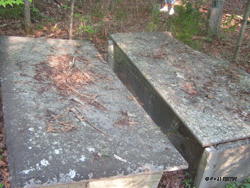
I sent some of the pictures to a local photographer friend who tried to bring out the details for me. She suggested I go back and take some more shots for her to play with.
I plan to go back out there in the fall to retake some shots. Photographs of old graves can provide some more clues if the lighting is different (hence, a different time of year and time of day). I will also take some water with me to sprinkle on the graves.
Yes, I will go out there again on another hike. But I think I will wait until the chigger bites heal!
Ahh, genealogy. It's fun hiking around the past, even if the present bites you.
Note: Many thanks to the wonderful folks at the Carmichael-Hemperley Funeral Home and Crematory on Senoia Rd in Peachtree City. They were super as they spent about an hour with me trying to find the old cemetery. I appreciate their kindness!
©2010 AS Eldredge
Monday, August 16, 2010
Dear Mary, The War is Over
Can you imagine the scene when General Lee made the decision to surrender on April 9, 1865, to General Grant? Can you imagine the heartache, the despair? General Lee was surrounded after the fall of Richmond and Petersburg. All he had was a tired, starving army and lots of Union soldiers between him and the supplies so badly needed.
It took great courage to surrender. The terms he requested of General Grant included immediate pardons for his army. Grant honored that request and also supplied some food to the starving Confederates. It took most of the day as the two generals sat and talked in Appomattox. By all accounts, they had not seen each other in over 20 years. Reports tell us they talked some of the past before they settled down to the business at hand.
The war was over. Can you imagine how much relief was felt by the men wearing their uniforms of blue and gray that day! The struggle was over. No longer would brother take arms up against his brother. They could go home. They could back to life.
With time, the Union would truly reunite. A note of interest is that after the Civil War, the United States of America becomes a single entity when referring to it.
What was it like on that fateful day? The following letter provides only a quick mention of Lee's surrender. More fighting would be in the future for other soldiers that day and many more to come.
The letter below was written by George LEMMON, of Co. F, 139th PA Infantry, at the end of the Civil War, to his cousin, Mary Shoop. The family of Mary Shoop has preserved the letters sent to her by her brother, George SHOOP, and plans to have the collection published.
A special thanks to her 2g-grandson, John Snowden, for giving me permission to publish this one letter of the collection on my genealogy blog.
Camp Near Burks Station, Va. April 30 {1865}
Cousin Mary,
Your welcome letter came to hand this morning. I was very glad to hear
from you. I am in good health at the present time. I hope these few lines
may find you all the same. We have been moving Camp today and building
summer quarters. We have gay quarters built but I donât think we will stay
here very long. I think we are going back to Richmond or Petersburg closer
to our base of supplies. The 5^th and 2^nd Corps moved in that direction
this morning. The report is that we will remain here a few days yet.
Well Mary, I did not get time to finish this letter last evening. I was
called on to draw rations. I will do as well as I can this morning. We had
some rain here in the night and looks as if it will rain more today. I
hope we will not have such a flood as you had the day I started to the
Regât.
I suppose you have heard all the news about the last battle. I got through
safe and was there when Lee surrendered to Grant. I was talking to your
brother George when the news came that he had surrendered. I tell you
there was a happy set of boys. The cheering went from one end of the line
to the other, and our caps was flying in the air and all the brass bands
was playing The Star Spangled Banner.
Well Mary, we got good news this morning that the rebel General Johnston
has surrendered to Sherman. If this story is true, we will soon get home.
I think the last battle has been fought. I donât want to hear another
cannon fired.
We got some very unwelcome news the other day about the assassination of
the President. It created great excitement in our camps for several days.
Well Mary I think I will close. Your brother George is well. I send my
best wishes to all the family. I will wait very patiently for an answer.
I remain, your cousin,
George Lemmon
Ahh, genealogy. Reading letters of the past can open our eyes. Perhaps you have some letters buried deep in your family?
©2010 AS Eldredge
Friday, August 13, 2010
Sighted! Johnny Reb in Union Camp!
Oh dear! How can Johnny Reb be listed in an union database?
This was similar to the question I recently asked myself when I saw an article on a National Graves Registration Project run by the Sons of Union Veterans of the Civil War. Wouldn't the database be just for those boys in blue?
While the project dates from 1996, the database is relatively new with a start date in 2005. The great news for all of us genealogy and history buffs is that it doesn't matter which side your beloved fought with during the War of the Northern Aggression!
Yes, the database accepts both Confederate and Union Civil War final resting spots. With this new found knowledge, I thought I'd give it a try.
The database is free to the public to search. However, if you want to contribute or correct entries, then you must sign up as a submitter and be approved. I don't know what the process is, but it took about one week for me to be approved.
Trying the database on for size!
According to estimates, over 4 million American men were part of the Recent Unpleasantness. Does it matter which side your blood flows from? No. These young men all fought for their vision of America and states' rights.
Just this morning, I submitted four names to the database. Two wore the blue uniforms and two wore the gray. I'll be interested in seeing how long it takes for them to be verified by the group. I still don't know the approval process, but I will find it interesting to see if they are approved at approximately the same time or if a delay is seen. Be aware you need to have quite a bit of information on your beloved in order to enter them. It takes more than the standard name, rank and serial number. The form asks for the unit, the date of enlistment, date of discharge, state fought for, company, dates of birth and death, and information on final resting spot. There is even a spot to indicate if there is a stone or if it needs replacing. Short comments can also be added.
And before you wonder, I am related to the four American heroes I submitted this morning. Yes, my blood has the Rebel Call as well as the Union Blue Glory coursing through my body.
Here is the site in case you want to check it out: http://www.suvcwdb.org/home/about.php
Ahh, genealogy. We are all red, white and blue patriots, even if some of our family fought for "the others." We are descendants of Americans who lived, fought, and sometimes, died for our freedoms.
Update: 12 hours later-- one each (Reb and Yank) has been approved and now available for viewing.
Update 2: 24 hours later-- All submitted beloveds have been added to the database. Guess I'll have to send more! This time, I'll send a Gettysburg Yank Hero and a Chickamauga Rebel Casualty. Yes, I am an equal opportunity battlefield history buff.
©2010 AS Eldredge
Thursday, August 12, 2010
Treasure Chest Thursday: Whirlwind of Treasure in Carnegie
In the last week or so, there has been a flurry of activity on the DOOLITTLE family of Carnegie, Allegheny, PA. It all started when I wrote a post on August 3 about cousin William James GLENN. Little did I know finding the Civil War personal war sketch at the CarnegieCarnegie site of the Andrew Carnegie Free Library & Music Hall in Carnegie, Allegheny, PA, could make me so happy.
Emails have been flying around since then from a descendant of Jacob DOOLITTLE (1809-1891) asking if I could assist with more documentation about his wife, Sarah CUBBAGE, and her family.
Sarah CUBBAGE was the daughter of Irishman George CUBBAGE and his wife, Nancy CALDWELL. I have not yet been able to find evidence that Nancy is one of my CALDWELL clan, but her 1791 birth in the same general neighborhood as my documented 1830ish births make it likely. To read more on CUBBAGE family, go to St Clair Cemetery.
The cool find for me in the email was the noting of the final resting place of Nancy CALDWELL CUBBAGE. She is listed at Venice Presbyterian Church Cemetery in McDonald, Washington, PA. Of more interest was noting Nancy's final resting spot uses the surname of her first husband, George CUBBAGE. My notes and research indicate she married Alexander EWING after the 1826 death of George.
A quick check with the descendant of George and Nancy confirmed what I thought I knew on the marriage to EWING.
To my knowledge, Jacob DOOLITTLE and Sarah CUBBAGE had five daughters. Two of them are of special interest to me.
Susan Belinda DOOLITTLE married into the LEA family-- that is, J W LEA of Carnegie. The LEA family was the neighbors, friends, and sometimes, spouses of my blood line. See a recent posting on Cassius M LEA, the husband of my 2g aunt.
The other daughter of Jacob and Sarah who married into my family was Martha E DOOLITTLE (1842-1907.) Martha was the wife of William James GLENN (1839-9018.)
Maggie (ah, how I love THAT name) of the Andrew Carnegie Free Library & Music Hall in Carnegie also contacted me to see if I could identify any of the gents in the picture they have of the Thomas Espy GAR Post as I have several cousins in that group. I took a quick look at the photo and realized that the odds of me recognizing the older men in full beards was basically little to none.
So, I started on a new journey of looking through old files and records to see if I could locate any pictures of some of these men when they were younger. I guess the folks at the library have most likely identified cousin George B FORSYTHE as my dearest cousin, his granddaughter, (yes, I know her) recently donated some more Civil War relics to the post.
I've also seen pictures of some of the GLENN men when they were younger. Could I see enough family resemblences in the pictures as they aged? I think not.
BUT-
I dug around and found some living descendants of William James GLENN! After making a phone call and leaving a message, it was now time to wait.
Today, I got the phone call. After speaking with the gentleman who confirmed his identity and his love of genealogy, my heart experienced a whirlwind of activity. Another connection to the past established! He has pictures! He has stories! And he has a cousin that he works with to research the past! Oh, glorious day!
Click to read the post that is causing such a whirlwind of activity: http://genitalesga.blogspot.com/2010/08/tombstone-tuesday-simply-i-am-survivor.html
Special note to Maggie at the library-- I hope to have some photo ids for you soon.
Ahh, genealogy. What treasures a whirlwind of new finds can be! Sometimes, it takes just a nudge from someone new to bring new energy to the hunt.
©2010 AS Eldredge
Friday, August 06, 2010
Arlington National Cemetery to Get a Much Needed Facelift in Burial Records
Yippee! There's almost nothing as disappointing as when a cemetery has been sloppy in keeping records or in finding out the old cemetery keeper of the information's family thought it worthless and threw it out. I'm so glad this project to preserve the burial records and information of our nation's heroes is getting the assistance it needs from volunteers! Read on......
Northern Virginia Technology Council Member Organizations to Assess Arlington National Cemetery's Information Technology Requirements
/PRNewswire/ -- The Northern Virginia Technology Council (NVTC) announced today that the Department of the Army has accepted in principle the organization's pro bono offer to provide assistance in the assessment of the information technology requirements to rectify the unacceptable state of the records at Arlington National Cemetery. This effort stems from an Army investigation earlier this year that found the Cemetery's record keeping in shambles, burial records on index cards, improperly marked graves and serious difficulties in accurately locating the graves in the cemetery. All these issues persisted despite spending more than $5 million on a program to digitize burial records that has shown no results.
In response to public reports of this serious problem to record keeping, the following 15 NVTC member companies have volunteered their assistance to constitute an assessment group: ACS, a Xerox Company; Blue Canopy; Booz Allen Hamilton; CACI; CGI; Consumer Electronics Association (CEA); Corporation for National Research Initiatives; CSC; IBM; Lee Technologies; MAXIMUS; Microsoft; MITRE; SoltechOne; and Vistronix.
"The NVTC membership is eager and willing to support the U.S. Army as it responds to this difficult situation. We want to ensure that we honor the women and men who served their country and, in many cases, gave the ultimate sacrifice for this nation. We are united in our willingness to support Senator Warner in his efforts to remedy this crisis," said George C. Newstrom, President and COO of Lee Technologies and former Secretary of Technology for then-Governor Mark Warner.
"NVTC is made up of the country's most well respected and innovative technology companies and this collaborative pro bono effort demonstrates their loyalty, compassion and admiration for those who served in the armed forces, many making the ultimate sacrifice," said Bobbie Kilberg, President and CEO, NVTC. "We applaud Senator Warner for his leadership in trying to resolve this important matter. NVTC looks forward to working under the direction of Army Secretary McHugh and his team to help assess Arlington Cemetery's technology requirements. It is an honor and privilege to be involved."
-----
©2010 AS Eldredge
Use Your Imagination to Investigate the Past
We've all heard it. "My family can't be found," or "The census didn't list slaves," or "The courthouse burned."
Well, yes, this can be a real mind blocker. Use your imagination when looking at various resources. Don't just depend on the census lists. And, for the sake of all genealogy racing heartbeats, don't grab a name from the census and plop it in your tree just "cause it was the same name." Like no name has ever been duplicated in history!!!!
Look at everything.
Examples include:
Wills
Estate Inventories - (can be great if the estate had owned slaves)
Land Records
Church Records
Cemetery Records
Bibles
Local County Histories
Orphans Court Records
Local Tax Records
Local Historical Societies
Local Genealogy Societies
Probate Court Records
Lawsuits - (I found a part of one family after I ordered the records about a trial.)
Asylum Records
Old Church Magazines
Journals of old genealogy societies
Newspapers of the era and place of interest (1888-1899 newspapers are great finds.)
Family History Library
As you look at every source you can find, have an open mind. Don't be stuck in the "blame game" of genealogy. Perhaps someone moved away. Perhaps someone was listed as "chattel." Perhaps you've looked in all the wrong places. Perhaps the trail has gone cold. Keep looking as it may warm back up one day.
My tip of the day: Be open as you continually search for documentation to support your theories. Be open to investigate the not-so-readily-available sources. Be open to traveling to the area of your interest and digging in the old records or hire someone to do it for you.
Use your imagination to investigate the past. And use the facts to document your current family trees.
Ahh, genealogy. It's only as good as the documented research. Otherwise, it can make a pretty good bed time story for the kids, not to mention the hair pulling of someone who has documented the facts:)
©2010 AS Eldredge
Subscribe to:
Posts (Atom)