Knowing how hard it can be to trace my ancestors who came to America from Europe, I can imagine the frustration of those who seek their history from Africa.
I ran across this announcement of a new resource for researching those with African origins who were brought to the Americas on slave boats. Perhaps, this will turn out to be helpful to those who are seeking their family history and roots from that area and timeframe.
New Website to Trace Origins of Enslaved Africans
/PRNewswire/ -- Little is known of the ancestry of Africans pulled into the trans-Atlantic slave trade. A new website, launched at Emory University this week, aims to change that. The African-Origins (http://www.african-origins.org) website provides a rare glimpse of the identities of Africans aboard early nineteenth-century slaving vessels, and through this information, the possibility of tracing the origins of millions of other Africans forcibly transported to the Americas. Public participation will be critical to piecing together this missing history.
Visitors to African-Origins can search an online database of Africans liberated from slaving vessels, with such details as gender, age, African port of departure, and, most importantly, an African name. Because names used within African languages and social groups have remained fairly consistent over the last two centuries, the thousands of names listed in this database are clues to the linguistic and ethnic origins of the Africans on board these vessels.
Scholars are now looking for help in identifying the modern counterparts of these names and the languages and ethnicities with which they are likely associated. Through the African-Origins website, those with knowledge of African languages and cultural naming practices can suggest these links. By taking a few minutes to search and listen for familiar names and contribute a modern counterpart, language, and ethnic group, members of the public can help identify the language, ethnic and geographic origins of people listed in these registers, and subsequently the likely origins of millions of other unnamed Africans enslaved during this period.
With these insights, scholars serving as editors of the database can consider the range of possible languages and groups affiliated with a name alongside historical research of peoples' locations and movements across Africa. As contributions are received and analyzed, new information will be added to the African-Origins database on the likely language and ethnicity of each individual. Visitors to the site will eventually be able to search for Africans by linguistic group and view maps of the historical locations of people pulled into the trans-Atlantic slave trade.
To find out more about the African Origins project or contact the project team, visit http://www.african-origins.org or email african-origins@emory.edu.
--
Ahh, genealogy. What trips our ancestors took!
©2011 AS Eldredge

Ahhh, genealogy. A glimpse of the past shows of what I am made.....
Showing posts with label slaves. Show all posts
Showing posts with label slaves. Show all posts
Wednesday, April 27, 2011

Monday, April 11, 2011
On the Eve of Civil War: "What is to be Done?"
How well I remember the parents of my friends finding Civil War artifacts on their farmland back in the late 1960s and early 1970s. Growing up in the South and in the general area through which Sherman's men trekked their way to the sea, it was not uncommon for an old artifact to find its way to the surface.
As a young adult, I lived near a battlefield outside of Atlanta for a number of years, and it still was not uncommon to find artifacts of the War after a hard rain. Why, we even had a foxhole or two on the hill behind the house as there was a three day skirmish in the area.
Recently, I spent a few days in Charleston, the town where the first shots of the Civil War were heard. Spending some time in the city via tourist style, I saw some beautiful old homes and heard some interesting stories about the American Revolution and the early days of Charleston.
History is alive in Charleston, and a lot of talk was about the upcoming anniversary of the War of Northern Aggression. It seems so strange to think our country was so divided that states seceeded from the Union and brothers and cousins fought each other.
I have also spent some in the last week looking at the Captain Thomas Espy GAR Post 153 in Allegheny Co, PA. I had several family members who were members of that little Civil War Veteran Group and I have found it fascinating to look online at the documentation and artifacts they have in their possession today.
Today, I heard talk of a protest in Atlanta over the lighting of a match. Lighting of a match? It would appear some groups don't think that having a plaque at or near the spot where Sherman ordered the burning of Atlanta is important. According to the group protesting the plaque, we shouldn't remember the event since it is also in the same area as another more recent movement. Their view is the plaque should be somewhere else. The burning of Atlanta did happen and Sherman's March to the Sea did have devastating effects on the South. And the order did come to burn Atlanta where the city of Atlanta was, and is. Where else should it be?
Leading up to the Civil War, there was much tension among the different groups. Sometimes, I wonder why different groups of today believe that we shouldn't remember the past. Honor your past, honor the past of others. The many trails we took as individuals have all come together to make us what we are now.
I came across some interesting articles in a northern newspaper, The Washington Reporter, from January 11, 1860.
The first is titled "Sand in Cotton Bales."
There is no doubt a very great difference between the economical relation of the North and the South, separately considered. The yankees are an ingenious people, a fact that is undisputed by either their friends of foes....It is the great relief of the disadvantages of slavery when the slave is brought intra mania--within the walls-- and made a portion of the family; and, as Horace Greely thinks, when the slaves and the whites, by co labor as mechanics or otherwise, become more intimate than can possibly be the case in field labor, there naturally arises a more sympathetic and philanthropic feeling between the parties. It would, we believe, be a happy thing for the slaves of the South should succeed in establishing their own manufactures.....
(The article is talking mostly about the sprinkling of sand in cotton bales, which increases the weight of the cotton, thus increasing the money received. According the article, the Yanks had been practicing that for years in different ways, for example, adding sand to brown sugar.)
....It cannot be supposed for a moment that the planters-- the very pinks of chivalry-- would sand the cotton themselves; no doubt that is done through the industry and ingenuity of their yankee overseers, and so far as that is concerned we hope our chivalric friends will not turn to and tar and feather the yankees on that account,....
Another article follows entitled "Emigration of Negroes from Arkansas"
In this article, the legislature of Arkansas has passed a law giving the Negroes the alternative of leaving to stay free or stay and become slaves. Of course, many left. Who wouldn't?
......What shall be done with the thousands of unfortunates who will be driven northward?-- This is a grave question, and our readers will see....that it is engaging earnestly the consideration of the leading minds of the country......
Senator Doolittle of Wiconsin said that the more important question was what to do with the free Negro as opposed to the slavery issue.
...He said the free States will not retain them; some of the Northern States enact stringent laws to prevent them from coming among them,.....
As we reflect on the Civil War and its effects on the nation and on our families, remember first that we are all Americans. As for me, I lost family members on both sides of the war. I still think of them, no matter what color uniform they wore. They all shared my blood, and my blood runs red for America.
Ahh, genealogy. Remember the past. After all, how can history teach us if we aren't willing to listen?
Source: The Washington Reporter, January 11, 1860
http://news.google.com/newspapers?nid=f1xuXVtw34IC&dat=18600111&printsec=frontpage&hl=en
©2011 AS Eldredge
As a young adult, I lived near a battlefield outside of Atlanta for a number of years, and it still was not uncommon to find artifacts of the War after a hard rain. Why, we even had a foxhole or two on the hill behind the house as there was a three day skirmish in the area.
Recently, I spent a few days in Charleston, the town where the first shots of the Civil War were heard. Spending some time in the city via tourist style, I saw some beautiful old homes and heard some interesting stories about the American Revolution and the early days of Charleston.
History is alive in Charleston, and a lot of talk was about the upcoming anniversary of the War of Northern Aggression. It seems so strange to think our country was so divided that states seceeded from the Union and brothers and cousins fought each other.
I have also spent some in the last week looking at the Captain Thomas Espy GAR Post 153 in Allegheny Co, PA. I had several family members who were members of that little Civil War Veteran Group and I have found it fascinating to look online at the documentation and artifacts they have in their possession today.
Today, I heard talk of a protest in Atlanta over the lighting of a match. Lighting of a match? It would appear some groups don't think that having a plaque at or near the spot where Sherman ordered the burning of Atlanta is important. According to the group protesting the plaque, we shouldn't remember the event since it is also in the same area as another more recent movement. Their view is the plaque should be somewhere else. The burning of Atlanta did happen and Sherman's March to the Sea did have devastating effects on the South. And the order did come to burn Atlanta where the city of Atlanta was, and is. Where else should it be?
Leading up to the Civil War, there was much tension among the different groups. Sometimes, I wonder why different groups of today believe that we shouldn't remember the past. Honor your past, honor the past of others. The many trails we took as individuals have all come together to make us what we are now.
I came across some interesting articles in a northern newspaper, The Washington Reporter, from January 11, 1860.
The first is titled "Sand in Cotton Bales."
There is no doubt a very great difference between the economical relation of the North and the South, separately considered. The yankees are an ingenious people, a fact that is undisputed by either their friends of foes....It is the great relief of the disadvantages of slavery when the slave is brought intra mania--within the walls-- and made a portion of the family; and, as Horace Greely thinks, when the slaves and the whites, by co labor as mechanics or otherwise, become more intimate than can possibly be the case in field labor, there naturally arises a more sympathetic and philanthropic feeling between the parties. It would, we believe, be a happy thing for the slaves of the South should succeed in establishing their own manufactures.....
(The article is talking mostly about the sprinkling of sand in cotton bales, which increases the weight of the cotton, thus increasing the money received. According the article, the Yanks had been practicing that for years in different ways, for example, adding sand to brown sugar.)
....It cannot be supposed for a moment that the planters-- the very pinks of chivalry-- would sand the cotton themselves; no doubt that is done through the industry and ingenuity of their yankee overseers, and so far as that is concerned we hope our chivalric friends will not turn to and tar and feather the yankees on that account,....
Another article follows entitled "Emigration of Negroes from Arkansas"
In this article, the legislature of Arkansas has passed a law giving the Negroes the alternative of leaving to stay free or stay and become slaves. Of course, many left. Who wouldn't?
......What shall be done with the thousands of unfortunates who will be driven northward?-- This is a grave question, and our readers will see....that it is engaging earnestly the consideration of the leading minds of the country......
Senator Doolittle of Wiconsin said that the more important question was what to do with the free Negro as opposed to the slavery issue.
...He said the free States will not retain them; some of the Northern States enact stringent laws to prevent them from coming among them,.....
As we reflect on the Civil War and its effects on the nation and on our families, remember first that we are all Americans. As for me, I lost family members on both sides of the war. I still think of them, no matter what color uniform they wore. They all shared my blood, and my blood runs red for America.
Ahh, genealogy. Remember the past. After all, how can history teach us if we aren't willing to listen?
Source: The Washington Reporter, January 11, 1860
http://news.google.com/newspapers?nid=f1xuXVtw34IC&dat=18600111&printsec=frontpage&hl=en
©2011 AS Eldredge
Friday, February 04, 2011
Online South Carolina Slave Records Keep Growing
A very special kudos to my genealogy buddy, Lowcounty Africana, for her dedication and ongoing spirit as she has built many pages for the free Footnote Collections on South Carolina Estate Inventories and Bills of Sale, 1732-1872.
She has transcribed the slaves' names of many of the early plantation owners and invites other family researchers to contribute pictures and documents to the pages.
Just in case you have roots in the lowcountry, you may want to check it out.
http://www.footnote.com/page/282783107_lowcountry_africana_south_carolina/
I keep watching in the hope you'll get around to finding an estate for one of my elusive ancestors.
Ahh, genealogy. Got to remember the past in order to learn and improve our future.
©2011 AS Eldredge
She has transcribed the slaves' names of many of the early plantation owners and invites other family researchers to contribute pictures and documents to the pages.
Just in case you have roots in the lowcountry, you may want to check it out.
http://www.footnote.com/page/282783107_lowcountry_africana_south_carolina/
I keep watching in the hope you'll get around to finding an estate for one of my elusive ancestors.
Ahh, genealogy. Got to remember the past in order to learn and improve our future.
©2011 AS Eldredge
Tuesday, August 17, 2010
Tombstone Tuesday: Bitten While Hiking to Shoot a Family

For instance, take a closer look at one of the recent requests to come my way. It seemed easy enough. All the lady wanted was some pictures of a couple of gravestones in the Old Landrum Family Cemetery in Fayette Co, GA.
Looking it up seemed easy to do. Here it was. And then I got lost.
 The description of the location was confusing as I am not an "oldtimer" of the area. The directions said, "accessible from the abandoned section of Peachtree Parkway." Hmm, abandoned Peachtree Parkway?
One fine, steamy day last week, I took a quick drive to the area I thought could be the abandoned Peachtree Parkway. Well, the area is all built up and even has an elementary school on it. So, if it was it, it's not now.
Being an enterprising young grasshopper, I popped into the first funeral home I saw. The kindly gentleman asked (in a oh-so-sorry-for-your-loss-gentle-voice) if he could be of service. I told him I was looking for a graveyard. One can imagine the looks on the faces as I beamed and said I wanted to shoot someone. Oops, clarification was needed. I wanted to photograph someone who was buried in a local cemetery and I couldn't find it.
Well, they couldn't either. The lady who was happily and joyfully assisting me at this point called City Hall to see what they knew. Nothing. But, they knew someone who would know.
My new buddy and I were looking at maps of the development of Peachtree City when she spotted an area called "Landrum's Mill Pond." About that time, the lady at City Hall called back and told us she has spoken to someone else at the library who said the cemetery was down a well worn path through the woods. She even had directions!
"Go up Hwy 74. Turn onto Peachtree Parkway, and turn left onto World Dr. Go to the cul-de-sac and park. Walk down the path and it will be in the woods."

Hiking, we went down the path which quickly showed evidence of asphalt and old faded lines. Eureka, it's the abandoned Peachtree Parkway that we didn't know existed! Hmm. No graveyard seen here. Let's start taking some of the paths off of this path.
At the second path I sent the kids and dogs down, they started yelling. "Come quick! It's a cemetery."
There sat the old Landrum Family Cemetery in a nicely fenced in area.

As I surveyed the area, I could see a spot where the trees were younger. Could this have been the site of the family home of Jeptha Landrum? He was the owner of the land from around 1825 or so, and is reported to have assisted the Creek Indians in their removal after the Creek Nation signed the land over to the state of Georgia. The Landrum family owned quite a large plantation and Landrum served the new county as a Judge and also as sheriff.
I don't know if the clearing with the young trees was the house site, but I can imagine the site if it had been. The cemetery would have been down the hill off of the dirt road leading to the house in an area close enough to visit, but not close enough to be disturbed by the creek or mill pond. The mill pond is still there and is further down the path from the cemetery.

We wiped off some of the stones as I snapped away. Some of the markings appear to be gone. Others, I can probably make out enough to match them with the index of the cemetery put online by a Landrum family member.
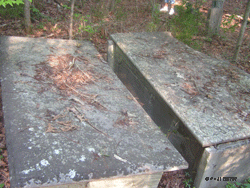
I sent some of the pictures to a local photographer friend who tried to bring out the details for me. She suggested I go back and take some more shots for her to play with.
I plan to go back out there in the fall to retake some shots. Photographs of old graves can provide some more clues if the lighting is different (hence, a different time of year and time of day). I will also take some water with me to sprinkle on the graves.
Yes, I will go out there again on another hike. But I think I will wait until the chigger bites heal!
Ahh, genealogy. It's fun hiking around the past, even if the present bites you.
Note: Many thanks to the wonderful folks at the Carmichael-Hemperley Funeral Home and Crematory on Senoia Rd in Peachtree City. They were super as they spent about an hour with me trying to find the old cemetery. I appreciate their kindness!
©2010 AS Eldredge
Subscribe to:
Posts (Atom)