Historical facts should not be a burden to the memory, but an illumination to the soul. – Lord Acton(1834-1902)
History is fascinating, although most students in school don't quite agree with the sentiment. How much can we learn about the past, our past, by digging into old documents as our country was being formed?
A cousin of mine and I have been hard at work digging and digging to try and uncover the definitive proof of the family of our Margaret McMillen (1762-1849).
She was born in Washington Co, PA, and died in Lower St. Clair, Allegheny, PA. While there is no mention of her father's name, she did name a son Thomas McMillen, so we suspect that was most likely her father's name. We have located three Thomas McMillens in the neighborhood, so trying to pin it down has been a struggle. One is the brother of the good Rev. John McMillen, and one is an Irishman who came much later than the birth of our Margaret.
The other one is probably ours. My cousin has been busy at the courthouse in Pittsburgh looking up land deeds, wills, and just generally scouring the countryside for any more leads. Yep, JoAnn, you've done a superb job of looking into almost every dark crevice in Allegheny Co.
The one good lead we have is that Margaret's son, Thomas M HENRY, was named as an executor for his uncle Thomas McMillen, who lived in Robinson Twp. So we know where he lived along the Piney Branch of Peters Creek, and we know he died in 1831. Too bad, he didn't mention his sister in the will written in 1829. Those mentioned in the will are his wife Mary, Mathew McMillen, John McMillen, Wm McMillen, James McMillen, Samuel McMillen, Joseph McMillen, Ebenezer McMillen and Anne McMillen. According to the will, Ebenezer is not yet 21.
Also from the Union Presbyterian Church Cemetery in Robinson are:
McMILLEN John 79 1840
McMILLIN John 60 1853
McMILLIN John 84 1922
McMILLIN John Y. 3 1899
McMILLIN Joseph 45 1852
McMILLIN Margaret 79 1898
McMILLIN Margaret 59 1918
McMILLIN Mary78 1844
McMILLIN Samuel
McMILLIN Sarah 80 1926
McMILLIN Thomas 76 1831
Just last night, JoAnn sent a new lead from A List Of Persons Names Exonerated On The Frontiers of Washington County for Being Distressed By The Incursions of Depredations of the Indians. Of course, a Thomas McMILLEN in Robinson Twp is mentioned on this 1789 document. Reading the names on the list is almost like looking at my family tree. So many familiar names are there. What was interesting to note is these men on this list did not have to pay taxes due to the damages they sustained during Indian attacks. Can you imagine this happening today? Can you imagine how bad it had to have been?
This little tidbit sent me on a journey this morning to learn more about the Indian attacks suffered by these early settlers. What I found in Boyd Crumrine's History of Washington County, Pennsylvania with Biographical Sketches of Many of Its Pioneers and Prominent Men (Philadelphia: L. H. Leverts & Co., 1882) made my hair stand on end.
Not only were there many instances of Indians attacking settlers, there were instances of men from Virginia who tried to "draft" the Pennsylvania men in to their militia. Now, to be fair, that little southwestern part of Pennsylvania was fought over by both Pennsylvania and Virginia. I just didn't realize the extent of the literal fighting, burning and killing by other settlers that accompanied that fight. Not only did the families of southwestern PA have to suffer Indian raids, they also suffered from the men of Virginia.
I also was enlightened to learn how the settlers attacked the peace loving Indians just "cause they were there." Interesting reading if you like history.
Onward genealogy buffs to the next lead of enlightenment.
Ahh, genealogy. Just can't top Lord Acton's words- Historical facts should not be a burden to the memory, but an illumination to the soul.
©2012 AS Eldredge

Ahhh, genealogy. A glimpse of the past shows of what I am made.....
Showing posts with label indians. Show all posts
Showing posts with label indians. Show all posts
Thursday, May 10, 2012

Friday, March 16, 2012
One Little, Two Little, Three Little.......
Just this week, another snippet of genealogy history for my family has made its way to my inbox. Yes, another kidnapping has happened. Ok, so it happened in 1782. However, the tale easily brought thoughts of horror at the events that took place on the CLOCK farm outside of present day Pittsburgh.
History reveals to the readers of today the struggles of the Indians as the white settlers moved west. As the western part of Pennsylvania became open for settlement, many Scot-Irish, including those who share my blood, moved to the area. Times were tough for these settlers. They had to clear the land, and build crude cabins. They had to plant crops and wait for a harvest. They had to be on the lookout for trouble, which usually came in the form of Indian attacks. They had to survive.
Who can blame the Indians? Treaties with them were routinely broken by the government. Their world was rapidly changing as more and more settlers came to claim the land while Indians believed the land belonged to no one person.
The settlers had to watch daily for Indian attacks. Usually these attacks were confined to the warmer months when living off the land was easier. The Indians had been made promises by the British if they would assist them in the Revolution in fighting against the patriots who so wanted their freedom from the power across the pond. This alliance proved quite deadly for the early settlers. Now, the Indians could savagely attack and butcher said patriots without fear of retaliation from the British. Unfortunately, for the Indians, the retaliation from mad-as-a-hornet Scotsmen or Irishmen or Frenchmen whose families were slaughtered seemed much worse.
Here is a snapshot of the newest Indian kidnapping and slaughter to come to my attention, thanks to cousin Susan.
Henry POTTER's young 10 year old daughter, Isabella, had gone to visit neighbors as was oft the case of the times. Women and children had a habit of banding together when the men were off from their hastily constructed cabins. Some roving Indians heard the men felling some trees and quickly killed them. They then went to the cabin with the women and children around and either killed them or took them captive. The gory details of the attack has been preserved by historians and can be read in full.
What horrors did young Isabella see as she watched her friends' heads being dashed against rocks or trees or brutally slaughtered? What horrors did she and her mother endure as they were kidnapped by these Indians and held for 18 months? The history books say they lived a life of drudgery. No doubt that is putting it mildly.
A search party led by George VALLANDIGHAM followed the events of that tragic day. While this particular search had to end when the Indians crossed over the Ohio River, other treks led by George VALLANDIGHAM were successful.
Why the interest of this story to me? The names POTTER and VALLANDIGHAM are intertwined with my beloved genealogy.
I have a cousin, Rachel DICKSON b. 1820 who married a Robert POTTER b. abt 1815. The DICKSON family lived in the same little area as the Henry POTTER family and others who share my blood. I suspect that the young Isabella could have been a cousin of Robert.
Robert is listed as the son of Adam POTTER (1788-1870) whose name is mentioned on several public family trees on Ancestry.com. By the time of the 1850 census which lists the names of the house occupants, Robert is gone and living with his bride. The 1820 census for Adam does show one male below the age of 10, so it is conceivable that Robert is this child. More evidence to support Robert being the son of Adam is found in Cushing's book where it states that Adam POTTER with sons Robert and Adam are remembered as residents before 1820 in North Fayette.
Adam POTTER was an attorney in the area and his name is listed as an executor for the will of Henry POTTER. I will speculate they were brothers. After all, how many POTTER families living in the general area of Noblestown in the late 1700s thru the 1800s weren't related?
Just to make these snippet shots even more interesting in my research, Isabella later married Robert BIGHAM (1805-1893). Robert married Jane GLENN (1812-1889), a cousin of mine through her grandfather who we share.
On to the VALLANDIGHAM connection----
My grandpa fought in the Washington Co Militia under the command of George VALLANDIGHAM. This is documented through the PA Archives. Other stories have surfaced over the years where my grandpa was also part of the group of men that hunted Indians that raided the area and massacred the settlers. The VALLANDIGHAM family were friends of my family as Clement, son of George VALLANDIGHAM and Elizabeth NOBLE, and Rebecca LAIRD (Clement's wife) raised my cousin after the untimely death of Rebecca's sister.
Rebecca's sister, Eleanor LAIRD, died shortly after the birth of her only child, Margaret Eleanor Laird Vallandigham HENRY. Margaret was the daughter of Samuel Smith HENRY who later becomes an Ohio State Representative. An old letter details how Samuel would visit his child and provided for her and her future education. Ahh, but that is another story for another day.
Now you can understand why the story of Isabella's kidnapping caught my attention. Perhaps her story will give you pause to reflect on the blood shed in the making of our great country.
Ahh, genealogy. Life flows on and on through our blood of the past.
Sources:
Cushing, Thomas. History of Allegheny Co, Chicago: A Warner Company, 1889
Larimer, Rev Bob. A 200th Anniversary of Noblestown
Allegheny County Will Book 3
Probate Index, Holmes Co, OH
©2012 AS Eldredge
History reveals to the readers of today the struggles of the Indians as the white settlers moved west. As the western part of Pennsylvania became open for settlement, many Scot-Irish, including those who share my blood, moved to the area. Times were tough for these settlers. They had to clear the land, and build crude cabins. They had to plant crops and wait for a harvest. They had to be on the lookout for trouble, which usually came in the form of Indian attacks. They had to survive.
Who can blame the Indians? Treaties with them were routinely broken by the government. Their world was rapidly changing as more and more settlers came to claim the land while Indians believed the land belonged to no one person.
The settlers had to watch daily for Indian attacks. Usually these attacks were confined to the warmer months when living off the land was easier. The Indians had been made promises by the British if they would assist them in the Revolution in fighting against the patriots who so wanted their freedom from the power across the pond. This alliance proved quite deadly for the early settlers. Now, the Indians could savagely attack and butcher said patriots without fear of retaliation from the British. Unfortunately, for the Indians, the retaliation from mad-as-a-hornet Scotsmen or Irishmen or Frenchmen whose families were slaughtered seemed much worse.
Here is a snapshot of the newest Indian kidnapping and slaughter to come to my attention, thanks to cousin Susan.
Henry POTTER's young 10 year old daughter, Isabella, had gone to visit neighbors as was oft the case of the times. Women and children had a habit of banding together when the men were off from their hastily constructed cabins. Some roving Indians heard the men felling some trees and quickly killed them. They then went to the cabin with the women and children around and either killed them or took them captive. The gory details of the attack has been preserved by historians and can be read in full.
What horrors did young Isabella see as she watched her friends' heads being dashed against rocks or trees or brutally slaughtered? What horrors did she and her mother endure as they were kidnapped by these Indians and held for 18 months? The history books say they lived a life of drudgery. No doubt that is putting it mildly.
A search party led by George VALLANDIGHAM followed the events of that tragic day. While this particular search had to end when the Indians crossed over the Ohio River, other treks led by George VALLANDIGHAM were successful.
Why the interest of this story to me? The names POTTER and VALLANDIGHAM are intertwined with my beloved genealogy.
I have a cousin, Rachel DICKSON b. 1820 who married a Robert POTTER b. abt 1815. The DICKSON family lived in the same little area as the Henry POTTER family and others who share my blood. I suspect that the young Isabella could have been a cousin of Robert.
Robert is listed as the son of Adam POTTER (1788-1870) whose name is mentioned on several public family trees on Ancestry.com. By the time of the 1850 census which lists the names of the house occupants, Robert is gone and living with his bride. The 1820 census for Adam does show one male below the age of 10, so it is conceivable that Robert is this child. More evidence to support Robert being the son of Adam is found in Cushing's book where it states that Adam POTTER with sons Robert and Adam are remembered as residents before 1820 in North Fayette.
Adam POTTER was an attorney in the area and his name is listed as an executor for the will of Henry POTTER. I will speculate they were brothers. After all, how many POTTER families living in the general area of Noblestown in the late 1700s thru the 1800s weren't related?
Just to make these snippet shots even more interesting in my research, Isabella later married Robert BIGHAM (1805-1893). Robert married Jane GLENN (1812-1889), a cousin of mine through her grandfather who we share.
On to the VALLANDIGHAM connection----
My grandpa fought in the Washington Co Militia under the command of George VALLANDIGHAM. This is documented through the PA Archives. Other stories have surfaced over the years where my grandpa was also part of the group of men that hunted Indians that raided the area and massacred the settlers. The VALLANDIGHAM family were friends of my family as Clement, son of George VALLANDIGHAM and Elizabeth NOBLE, and Rebecca LAIRD (Clement's wife) raised my cousin after the untimely death of Rebecca's sister.
Rebecca's sister, Eleanor LAIRD, died shortly after the birth of her only child, Margaret Eleanor Laird Vallandigham HENRY. Margaret was the daughter of Samuel Smith HENRY who later becomes an Ohio State Representative. An old letter details how Samuel would visit his child and provided for her and her future education. Ahh, but that is another story for another day.
Now you can understand why the story of Isabella's kidnapping caught my attention. Perhaps her story will give you pause to reflect on the blood shed in the making of our great country.
Ahh, genealogy. Life flows on and on through our blood of the past.
Sources:
Cushing, Thomas. History of Allegheny Co, Chicago: A Warner Company, 1889
Larimer, Rev Bob. A 200th Anniversary of Noblestown
Allegheny County Will Book 3
Probate Index, Holmes Co, OH
©2012 AS Eldredge
Friday, March 25, 2011
Fearless Females: Grandma Massey Harbison, Surviving an Indian Kidnapping in 1792
Fearless and courageous are only two of the words used to describe Massey (Massa) White HARBISON. Her story still makes me catch my breath every time I read it.
Massey WHITE, a child of American Revolution patriot Edward WHITE, was born in 1770 and witnessed early American history firsthand. She is believed to have witnessed battles close to her home in Somerset County, NJ. Her father relocated the family to western Pennsylvania, and that is where her hair raising story really begins.
Massey married John HARBISON in 1787 and they became one of the first settlers on the headwaters of Chartier's Creek in the northwestern part of Westmoreland County, Pennsylvania. They were accustomed to making mad dashes to nearby blockhouses when the Indians attacked and killed the locals.
John fought in St. Clair's army and was wounded when St. Clair and men suffered a huge defeat against the western Indian tribes in 1791. After he had healed, he served as an Indian Scout in the Allegheny frontier.
In May of 1792, Indians attacked their home while John was away and dragged Massa and her children out of bed. One of the small boys was crying such that the Indians dashed his head on the doorstep, before stabbing and scalping him. To her horror, Massey and her remaining two children were taken hostage.
Many of her captives were known to her and could speak English.
As the band of Indians and their captives were crossing down a steep bank to the Allegheny River, Massey threw herself off the horse. The horse that carried her son fell and injured her son. The Indians then killed him. She wrote, .."When I beheld this second scend of inhuman butchery, I fell to the ground senseless, with my infant in my arms..." (1).
When she awoke, she saw the scalp of her child on the ground and was beaten yet again. They later crossed into the Indian side of the country. She thought death would be welcome at this point, and expected to die when she threw down the powder horn (not once, but three times) that the Indians forced her to carry (as she was carrying her infant.)
She passed the first night of her captivity with her arms pinioned to her back and with a savage to each side of her. The next morning, Massey bravely tried to take a tomahawk before being detected. Quick on her feet, she explained her infant was trying to play with it.
The Indians had been successful in losing the settlers and were vigilant in their lookout for pursuit. The second night, Massey was moved to another station. The next morning, some of the Indians went off again to see if the settlers could be seen. Massey faked being asleep, and her one remaining guard did fall asleep. She grabbed a pillowcase and hankerchief and made her escape. She changed courses several times during her escape in order to deceive the Indians. The Indians did search for her and came close to her hiding spot. She stuffed the cloth in her infant's mouth to keep him quiet. For over two hours, the Indian stood still and close to her hiding spot. He did not leave until his friends called for him.
She crossed the creek above Pittsburgh and found a path to follow. For a few days, she wandered trying to find help, while fearful of being detected by the Indians. She despaired that both she and her infant would die. Only the thought of her infant dying after her kept her determined to find help.
When she heard a cow bell and saw some settlers, she called out to them. They asked her name, and checked to see if it was a trap. When one of the men saw her condition, he asked her again who she was. It was one of her neighbors who knew her but did not recognize her in the week since she had been gone. Her appearance and voice had been altered.
Massey survived, although the events of the kidnapping altered her life forever. Her story was told and retold after the event in newspapers of the time. In 1825, she published a book on the ordeal.
You can call her brave. I can call her grandma. You see, her daughter, Margaret, is the third wife of my 4g grandfather. While I don't share her blood, Massey was the only grandmother my 3g and 2g grandfathers knew.
There is a park named for Massey as well as a DAR chapter in Pennsylvania.
Ahh, genealogy. Honoring the amazing women in my family history makes me so thankful for them and their sacrifices.
Sources:
(1) Flood Tides Along the Allegheny by Francis R Harbison, 1941.
http://digital.library.pitt.edu/cgi-bin/t/text/pageviewer-idx?c=pitttext;cc=pitttext;xc=1;idno=00z836437m;g=text-all;xg=1;q1=massey%20harbison;frm=frameset;view=image;seq=7;page=root;size=s
History of Butler County Pennsylvania, 1883
http://www.rootsweb.ancestry.com/~pabutler/1883/83-02.htm#massy
Alle-Kiski Valley.com
http://akvalley.com/history/pioneers/massa/massa.shtml
©2011 AS Eldredge
Massey WHITE, a child of American Revolution patriot Edward WHITE, was born in 1770 and witnessed early American history firsthand. She is believed to have witnessed battles close to her home in Somerset County, NJ. Her father relocated the family to western Pennsylvania, and that is where her hair raising story really begins.
Massey married John HARBISON in 1787 and they became one of the first settlers on the headwaters of Chartier's Creek in the northwestern part of Westmoreland County, Pennsylvania. They were accustomed to making mad dashes to nearby blockhouses when the Indians attacked and killed the locals.
John fought in St. Clair's army and was wounded when St. Clair and men suffered a huge defeat against the western Indian tribes in 1791. After he had healed, he served as an Indian Scout in the Allegheny frontier.
In May of 1792, Indians attacked their home while John was away and dragged Massa and her children out of bed. One of the small boys was crying such that the Indians dashed his head on the doorstep, before stabbing and scalping him. To her horror, Massey and her remaining two children were taken hostage.
Many of her captives were known to her and could speak English.
As the band of Indians and their captives were crossing down a steep bank to the Allegheny River, Massey threw herself off the horse. The horse that carried her son fell and injured her son. The Indians then killed him. She wrote, .."When I beheld this second scend of inhuman butchery, I fell to the ground senseless, with my infant in my arms..." (1).
When she awoke, she saw the scalp of her child on the ground and was beaten yet again. They later crossed into the Indian side of the country. She thought death would be welcome at this point, and expected to die when she threw down the powder horn (not once, but three times) that the Indians forced her to carry (as she was carrying her infant.)
She passed the first night of her captivity with her arms pinioned to her back and with a savage to each side of her. The next morning, Massey bravely tried to take a tomahawk before being detected. Quick on her feet, she explained her infant was trying to play with it.
The Indians had been successful in losing the settlers and were vigilant in their lookout for pursuit. The second night, Massey was moved to another station. The next morning, some of the Indians went off again to see if the settlers could be seen. Massey faked being asleep, and her one remaining guard did fall asleep. She grabbed a pillowcase and hankerchief and made her escape. She changed courses several times during her escape in order to deceive the Indians. The Indians did search for her and came close to her hiding spot. She stuffed the cloth in her infant's mouth to keep him quiet. For over two hours, the Indian stood still and close to her hiding spot. He did not leave until his friends called for him.
She crossed the creek above Pittsburgh and found a path to follow. For a few days, she wandered trying to find help, while fearful of being detected by the Indians. She despaired that both she and her infant would die. Only the thought of her infant dying after her kept her determined to find help.
When she heard a cow bell and saw some settlers, she called out to them. They asked her name, and checked to see if it was a trap. When one of the men saw her condition, he asked her again who she was. It was one of her neighbors who knew her but did not recognize her in the week since she had been gone. Her appearance and voice had been altered.
Massey survived, although the events of the kidnapping altered her life forever. Her story was told and retold after the event in newspapers of the time. In 1825, she published a book on the ordeal.
You can call her brave. I can call her grandma. You see, her daughter, Margaret, is the third wife of my 4g grandfather. While I don't share her blood, Massey was the only grandmother my 3g and 2g grandfathers knew.
There is a park named for Massey as well as a DAR chapter in Pennsylvania.
Ahh, genealogy. Honoring the amazing women in my family history makes me so thankful for them and their sacrifices.
Sources:
(1) Flood Tides Along the Allegheny by Francis R Harbison, 1941.
http://digital.library.pitt.edu/cgi-bin/t/text/pageviewer-idx?c=pitttext;cc=pitttext;xc=1;idno=00z836437m;g=text-all;xg=1;q1=massey%20harbison;frm=frameset;view=image;seq=7;page=root;size=s
History of Butler County Pennsylvania, 1883
http://www.rootsweb.ancestry.com/~pabutler/1883/83-02.htm#massy
Alle-Kiski Valley.com
http://akvalley.com/history/pioneers/massa/massa.shtml
©2011 AS Eldredge
Tuesday, August 17, 2010
Tombstone Tuesday: Bitten While Hiking to Shoot a Family

For instance, take a closer look at one of the recent requests to come my way. It seemed easy enough. All the lady wanted was some pictures of a couple of gravestones in the Old Landrum Family Cemetery in Fayette Co, GA.
Looking it up seemed easy to do. Here it was. And then I got lost.
 The description of the location was confusing as I am not an "oldtimer" of the area. The directions said, "accessible from the abandoned section of Peachtree Parkway." Hmm, abandoned Peachtree Parkway?
One fine, steamy day last week, I took a quick drive to the area I thought could be the abandoned Peachtree Parkway. Well, the area is all built up and even has an elementary school on it. So, if it was it, it's not now.
Being an enterprising young grasshopper, I popped into the first funeral home I saw. The kindly gentleman asked (in a oh-so-sorry-for-your-loss-gentle-voice) if he could be of service. I told him I was looking for a graveyard. One can imagine the looks on the faces as I beamed and said I wanted to shoot someone. Oops, clarification was needed. I wanted to photograph someone who was buried in a local cemetery and I couldn't find it.
Well, they couldn't either. The lady who was happily and joyfully assisting me at this point called City Hall to see what they knew. Nothing. But, they knew someone who would know.
My new buddy and I were looking at maps of the development of Peachtree City when she spotted an area called "Landrum's Mill Pond." About that time, the lady at City Hall called back and told us she has spoken to someone else at the library who said the cemetery was down a well worn path through the woods. She even had directions!
"Go up Hwy 74. Turn onto Peachtree Parkway, and turn left onto World Dr. Go to the cul-de-sac and park. Walk down the path and it will be in the woods."

Hiking, we went down the path which quickly showed evidence of asphalt and old faded lines. Eureka, it's the abandoned Peachtree Parkway that we didn't know existed! Hmm. No graveyard seen here. Let's start taking some of the paths off of this path.
At the second path I sent the kids and dogs down, they started yelling. "Come quick! It's a cemetery."
There sat the old Landrum Family Cemetery in a nicely fenced in area.

As I surveyed the area, I could see a spot where the trees were younger. Could this have been the site of the family home of Jeptha Landrum? He was the owner of the land from around 1825 or so, and is reported to have assisted the Creek Indians in their removal after the Creek Nation signed the land over to the state of Georgia. The Landrum family owned quite a large plantation and Landrum served the new county as a Judge and also as sheriff.
I don't know if the clearing with the young trees was the house site, but I can imagine the site if it had been. The cemetery would have been down the hill off of the dirt road leading to the house in an area close enough to visit, but not close enough to be disturbed by the creek or mill pond. The mill pond is still there and is further down the path from the cemetery.

We wiped off some of the stones as I snapped away. Some of the markings appear to be gone. Others, I can probably make out enough to match them with the index of the cemetery put online by a Landrum family member.
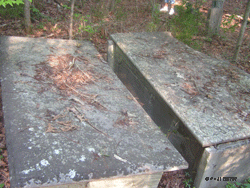
I sent some of the pictures to a local photographer friend who tried to bring out the details for me. She suggested I go back and take some more shots for her to play with.
I plan to go back out there in the fall to retake some shots. Photographs of old graves can provide some more clues if the lighting is different (hence, a different time of year and time of day). I will also take some water with me to sprinkle on the graves.
Yes, I will go out there again on another hike. But I think I will wait until the chigger bites heal!
Ahh, genealogy. It's fun hiking around the past, even if the present bites you.
Note: Many thanks to the wonderful folks at the Carmichael-Hemperley Funeral Home and Crematory on Senoia Rd in Peachtree City. They were super as they spent about an hour with me trying to find the old cemetery. I appreciate their kindness!
©2010 AS Eldredge
Subscribe to:
Posts (Atom)